
Curriculum

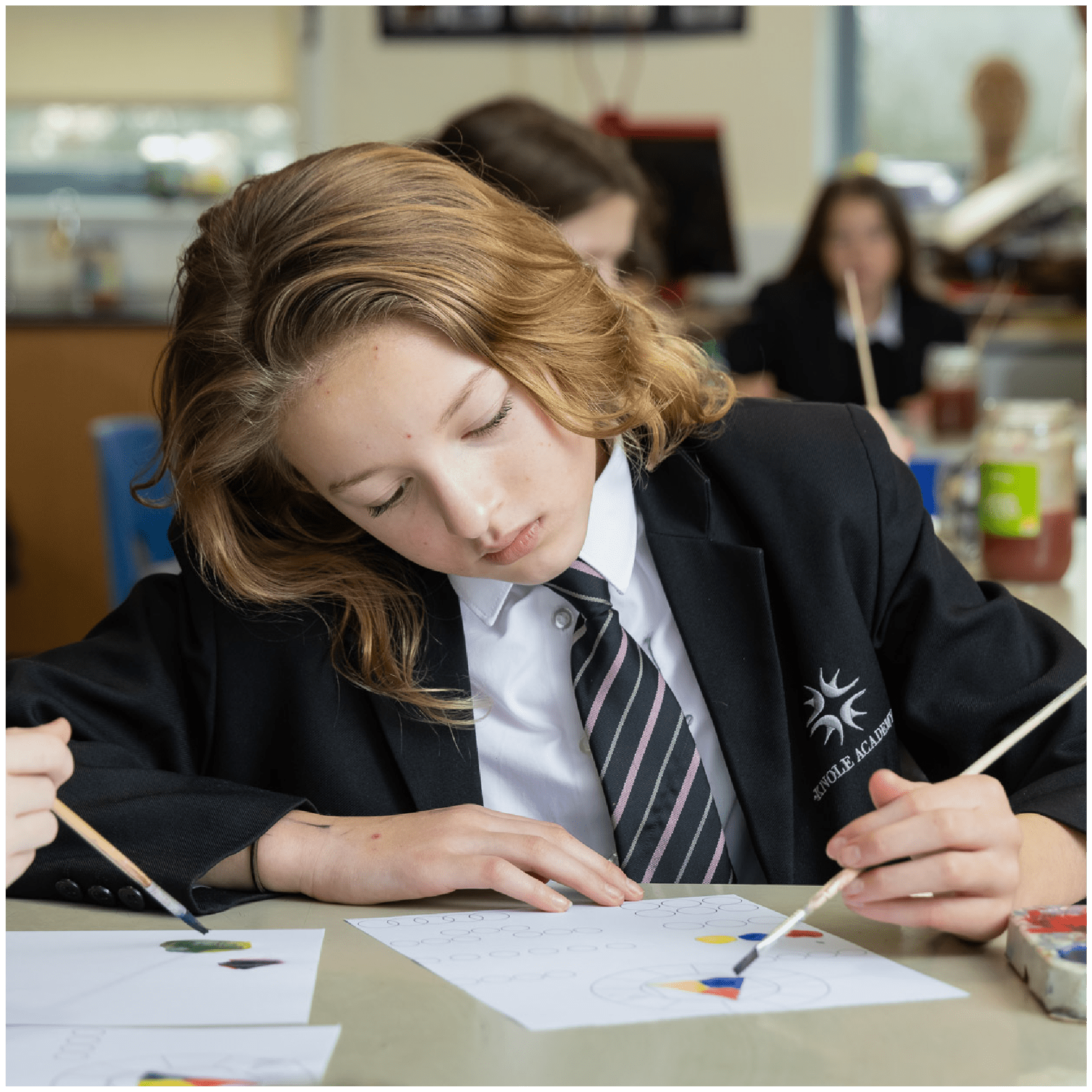
Students’ understanding and enjoyment of art and design will be developed through activities that bring together knowledge, understanding and skills.

They learn about the planning and design stages of a piece of work, and acquire the skills and techniques needed and use these to produce individual responses to starting points.

They learn about the ways in which artists, designers and craftspeople work.

We cover the history of art and how links can be made with pupils’ own work. This is also known as ‘critical studies’.

All pupils are taught in mixed ability groups of up to 25 students. Throughout each academy year students will have blocks of time with a number of art and design teachers who have different specialisms.

In addition to lesson work, challenging homework tasks are set each week.

Visits to galleries and museums are planned for each year group for which we ask parents for a voluntary donation.

Students are supplied with most equipment for their work

As part of the ethos of an aspiring Arts College the academy has an arts-based curriculum with a generous time allowance for visual art.

Key Stage 3 students have 2 x 50 minute periods per week.
Key Stage 4 students have 3 x 50 minute periods per week.
Key Stage 5 students have 6 x 50 minute periods per week.


KEY STAGE 3

Much of our work is based on the main themes of Still Life, Landscapes, Nature and Portraiture

In Year 7 we aim to teach students the necessary skills to work confidently and produce pieces done to a high standard.  Students learn how to plan and organise their work and use art studios safely and efficiently.
Work done includes drawing, painting, collage, printmaking, sculpture and hand embroidery.
Critical studies work looks at artists who focus upon the natural and manmade world.

In Year 8 we build upon skills and extend the range of media used. Students have more opportunity to work independently.
Projects include drawing, painting, sculpture, weaving, printing, hand and machine embroidery.
Critical studies looks at art and craft work done by non-western cultures, as well as the the themes of portraiture, landscape and townscape and still life

In Year 9 additional skills are taught and students are expected to make more personal responses to starting points.
The work includes drawing, painting, batik, screen printing, hand and machine embroidery.
The work done is based upon the main themes and critical studies focus upon artists and designers working in the 20th and 21st centuries.

Assessment

All work is regularly assessed. Grades A to D are used for attainment.
National curriculum levels are awarded at the end of each unit of work. Students are set challenging but realistic targets each year. Students are assessed at the end of Key Stage 3 based upon their teachers’ judgements of the work done. The majority of students reach level 5 and above by the end of the Key Stage.

Each student’s ability is assessed in the subject and we have a significant numbers of students that we are fast tracking into early entry GCSE.  They will then have the option to begin their AS level studies in this subject one or two years earlier than usual.

Recently we had a group of students take GCSE one year early. 90% were awarded A* or A grades.


Key Stage 4 GCSE

Art is optional at Key Stage 4 but we always have a very good up-take.

The course is designed to build upon the work done at Key Stage 3.
Many of the skills and techniques already covered will be used in addition to the introduction of new ways of working.
There will be ample opportunity for students to produce work that reflects their individual interests and abilities.
We aim to develop what students can do and for this reason anyone who is enthusiastic about art will do well.

At the academy we are able to offer the following practices:

  • Drawing, Painting and Collage
  • Printmaking
  • Dyed and Printed Fabrics
  • Weaving and Quilting
  • Hand and Machine Embroidery
  • 3D Construction
  • Graphics and Computer Aided Design
  • Digital Photography

An understanding of the history of art and how artists and designers work is an important part of the GCSE Art and Design course. We make visits to galleries and museums and spend time looking at art work done throughout history.
Artists are invited to work in the academy with GCSE students whenever possible.
The imaginative use of sketchbooks both in the academy and at home is essential.

Students are required to develop practical and theoretical knowledge and understanding of:

  • how ideas are expressed in images and artefacts
  • a range of art and design processes in two and three dimensions
  • how art relates to social, historical and cultural context.

Assessment

This is done at the end of the course by:

  • a folder of course work done over five terms (60% of total marks) 
  • a ten hour practical exam done in two days (40% of total marks).

Each candidate’s most successful work, together with the preparatory studies and sketchbooks, is then displayed in an exhibition in the art department.

Parents, students and friends of the academy are invited to view this work.


Key Stage 5 Advanced Subsidiary and Advanced GCE

Art is a popular subject at advanced level; it progresses naturally from GCSE but makes strong demands on students.
The course is designed to meet the needs of students who either wish to undertake further studies in the subject or for those who aim to take up careers for which an art and design background is essential.
Throughout the course students have many opportunities to work with practising artists and to take part in a full programme of gallery visits and lectures.

Students may concentrate their studies in one specialist area of art or may cover as wide a range of practices as resources and expertise allows. Work is exhibited in the academy, at the end of each year. Parents, students and friends of the academy are invited to view this work.
Currently we offer:

  • Fine Art (including Sculpture and Printmaking)
  • Fashion and Textiles
  • Graphics and Photography

The Advanced Subsidiary course consists of two units of coursework and an externally set exam.
The Advanced course consists of the successful completion of AS, two further coursework units and a final examination.

Assessment

At the end of the courses students mount exhibitions of their work.
Marks are given according to how well candidates have shown:

Visual Research and Investigation
Formation and Development of Ideas
Realisation of Ideas
Context and Evaluation

Further and Higher Education in Art

Art students who wish to go on to college courses are given assistance with their applications and in the preparation of their portfolios of work which are always needed at interview.
All students who have applied for such courses have been successful.

Many of our former students have achieved degrees and are now pursuing careers in the art and design field.