
- You are here
- Homepage
- Departments
- History
- Curriculum
Curriculum
History is a subject that everyone can enjoy because it is the story of your own family, your town and country and the world that you live in. When you start your studies in Year 7 you begin an investigation that can lead to a life long enjoyment and appreciation of the past.
Throughout your time at Knole Academy you will be encouraged to seek out evidence, interview people and form your own opinions. Working alone, in pairs and in groups you will be expected to achieve high standards of individual and team work. You won’t just be asked to write essays or answer questions. Instead we want you to find interesting ways to share your ideas. Sharing thoughts can be fun through the use of drama or verbal presentations. Information can be very colourful and attractively presented with hand drawn or ICT produced pictures and graphs.
KEY STAGE 3:
What will you be studying at Key Stage 3?
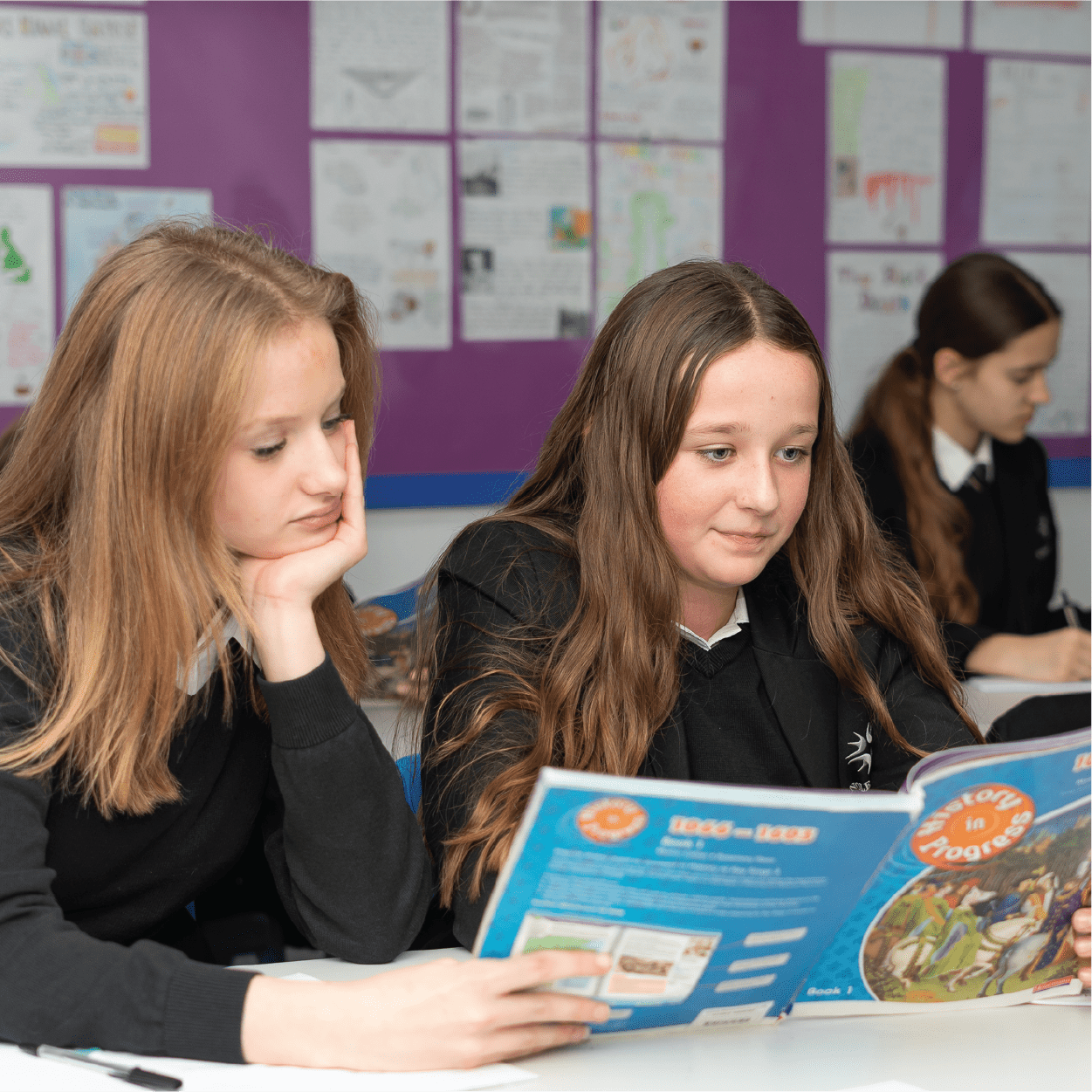
You will be studying a curriculum that will help you become very familiar with the national history of Britain and of other countries and cultures around the world and from the past.
You will study a number of units each year. Work in each unit will be focussed on a particular topic with an emphasis on gaining skills you need in later life. Assessments given each term will inform you of your progress and help you and your teacher set targets for your future work.
Currently students study the following units:
|
Year |
UNIT |
|||
|
1 |
2 |
3 |
||
|
7 |
‘The Detectives’ (historical skills) |
Ruling in Britain 1066-1603 |
Living and Working in the world 1066-1603 |
Moving and travelling around the world 1066-1603 |
|
8 |
Ruling in Britain 1603-1901 |
Living and Working in the world 1603-1901 |
Moving and Travelling around the world 1603-1901 |
|
|
9 |
The Twentieth Century World
|
|||
Teaching Methods
The majority of lessons involve paired and group work, individual study and development of extended written answers, class discussion and staff led presentations. Lessons are very interactive and pupils are invited to role-play, hot seat and act out historical enquiries. The department also runs field trips to aid understanding of the topics covered. In Year 7 pupils visit a ‘working’ medieval village and castle. Year 8 pupils visit Hampton Court and Year 9 experiences the First World War through a trip to the Belgian battlefields. The department is also keen to encourage the use of numeracy, literacy and ICT within the study of History.
Assessment
The History Department assesses progress using a variety of methods. In addition to Assessment for Learning using questioning techniques, teacher comments and appraisal, each pupil will undertake at least two formally assessed pieces of work each year. After each assessment pupils will review their performance with their teacher and together they will set individual targets to help them improve in the future. There is also an end of year written exam which enables staff to record achievement in relation to the National Curriculum. Pupils also have the opportunity to regularly reflect and evaluate their own work to help them progress through the national curriculum levels.
Homework
Written work is set on a regular basis and students will be expected to undertake research in the school library at lunch times and in local libraries outside of school hours. Pupils are also expected to learn the spellings and definitions of ten key words in each topic they study. This is a literacy target.
Equipment
Students will need a variety of pens, ruler, pencil, coloured pencils, calculator and dictionary.
How Parents Can Help
As the Key Stage 3 curriculum is the study of people and world affairs, discussion of items in the news is a useful aid to understanding history. Parents are also encouraged to discuss the historical topics under study with their daughters. Many historical sites are available locally and consideration should be paid to visiting them. A positive encouragement should be given to students to undertake research and make active use of all resource materials from library books, to films, to documentaries and the Internet. Students should feel able to submit “word processed” work at any time.
KEY STAGE 4:
History at GCSE is a series of enquiries based on historical evidence. Students will study a wide variety of different areas of history using mediums such as trips, the internet, power point, video, hot seating and role-play.
Medicine and Treatment
An examination of people’s understanding, treatment and prevention of illness through time. The course covers British and World History from the Roman Empire to the present day. Key individuals such as Louis Pasteur and Alexander Fleming are studied alongside the role of war, religion and chance in the development of medicine. Primary sources are an important part of the study and use of them forms one unit of the two assessed modules in this study.
Life in Germany 1919-1945
An in-depth study of the Weimar Republic and the Third Reich. Why did Hitler come to power? What were his policies and what was life like for women and children in Germany during this period? How did Germany recover from recessions? What were Nazi beliefs about race and what effect did they have?
Representations of History: Government and Protest in the USA 1945-1979
This module replaces the previously set coursework and will be examined in the classroom under controlled conditions. Students will study the topic, including documents that will be used in the final assessment, before completing a semi-prepared assessment. Issues studied will include The Civil Rights Movement 1945-1970, the presidencies of Eisenhower, Kennedy and Johnson and protest and assassination as a means of achieving political change.
Assessment
The final grade will result from controlled assessment in school and examinations that are marked externally. Students will complete a controlled assessment which represents 25% of the final mark. There are three examination papers that assess the modules on Medicine and Treatment (2 examinations) and Life in Germany 1919-1945. Each examination represents 25% of the final mark. These examinations are taken in the June of year 11.
Future Opportunities
History is a highly regarded qualification and teaches important skills relevant to many future career opportunities. For example, history develops clear analytical and communication skills that are useful beyond the study of history. History qualifications lead to careers in areas such as the police force, research, law, finance, sales, media and marketing, education and journalism. A GCSE in this subject would be very useful for a number of post 16 courses including law, media studies, English and, of course, history.
KEY STAGE 5:
Why choose history?
History is not just the study of the past. When we study our ancestors and why they did what they did, we are investigating human behaviour and learning more about ourselves. This History A level allows students to develop skills needed for adult life, such as the ability to question and solve problems.
How will it help my career?
A History A level is a well-respected qualification, not just by universities but by employers also. With a qualification in History you could go on to Higher Education, not just to study History, but any one of the many arts and social sciences courses available. With or without a degree, you can use a History qualification to work in a great variety of jobs in business and administration, the police service, the law, journalism and the media (as well as the more obvious careers like teaching or working in museums and libraries).
What do you do?
The course is made up of 2 different types of unit for AS level (4 for A Level). There is scope to examine key historical topics at first hand, through original sources, investigate a current major historical controversy, look at an historical period in depth and complete individual investigations on approved topics.
Content:
AS History, 50% of the full A level
- Domestic Developments 1918-1951 in Britain, including the impact of the First World War, the General Strike, the Rise of Fascism, the Rise of the Labour Party and the Second World War
- Dictatorship and Democracy in Germany 1933-1963, including the transformation of Germany under the Nazis, the division of Germany after the Second World War and the events that impacted on the success of the ‘two’ Germanies up to 1963.
A Level, as above plus:
-
Civil Rights in the USA 1865-1992, including the struggle for equality of African
Americans, Native Americans, Trade Unions and Women - Coursework on a topic of your choice (1 piece on investigation/ sources, 1 piece on interpretations of an historical figure or event)
Assessments:
AS – 2 exams (1.5 hours each), 1 is essay based and the other is source based. Each worth 50% of total AS grade, 25% of total A level grade.
A Level – 1 exam (2 hours), essay based, worth 30% of total A level grade. Coursework; 2 extended essays of up to 2,000 words worth 20% of final A level grade.